

For centuries, the colours of Rajasthan’s textiles did not come from laboratories or synthetic pigments. They emerged slowly from the land itself — from fallen fruits, dried flowers, aged roots, and fermented leaves gathered across forests, orchards, and fields.
Before industrial dyes existed, artisans developed remarkably sophisticated ways to extract lasting colour from plant matter that had matured, dried, or naturally decomposed. These processes relied on time, patience, mineral-rich water, and deep empirical knowledge of how fibres absorb pigment.
The result was a palette intrinsically connected to earth: indigo blues, terracotta reds, saffron golds, and gentle yellow-greens — tones still associated with Rajasthan’s textile heritage today and deeply resonant with the Safeera aesthetic.
Colour from What Has Fallen
One of the most distinctive aspects of traditional dyeing in Rajasthan is that colour often came not from freshly cut plants but from botanical material that had already completed part of its natural life cycle.
Dried pomegranate rinds, forest fruits that had fallen to the ground, flowers gathered after dropping from trees, and roots aged in storage all produced richer and more stable dyes than fresh material. Artisans understood that as plant matter dried or oxidised, tannins and pigments concentrated — deepening both colour and permanence.
This approach meant dyeing traditions worked with seasonal abundance and natural cycles rather than against them — a philosophy that continues to inform Safeera’s preference for earth-derived colour.
Pomegranate Rind: Soft Gold from Orchard Waste
Sun-dried pomegranate peels have long been used across Rajasthan as a tannin-rich dye source. Once the fruit is consumed, the remaining rind is dried and aged, then soaked or simmered to release warm yellow, olive, or beige tones.
Beyond its gentle colour, pomegranate rind also functions as a natural mordant — helping other plant dyes bind more firmly to cotton and silk. In many traditional processes, it formed the quiet foundation beneath brighter colours layered later.
Harda Fruit: Preparing Cloth to Receive Colour
Harda (myrobalan) fruits are often collected after naturally falling and drying. Their aged flesh contains high tannin content, which lightly tints fabric pale yellow-green while fundamentally preparing fibres to accept subsequent dyes such as indigo or madder.
In Rajasthan’s dyeing and block-printing traditions, harda treatment is frequently the first step in colouring cloth. It represents an invisible but essential stage — strengthening the bond between plant pigment and textile fibre.
Indigo: Blue Born from Fermentation
Perhaps the most extraordinary of Rajasthan’s natural dyes is indigo, created through the controlled fermentation of harvested leaves. When submerged in water, the leaves begin to break down, triggering biochemical changes that release the famous blue pigment.
The colour does not exist visibly in the fresh plant; it appears only through fermentation and oxidation. Artisans precipitate this pigment into paste or cakes, later dissolving it again in dye vats. Each immersion of fabric deepens the blue — from pale sky to deep midnight.
Indigo exemplifies how traditional dyeing relied on living processes rather than simple extraction.
Madder Root: Earth Reds Matured by Time
Madder roots, known locally as manjistha or aal, are typically dried and aged for months before dyeing. As the roots mature, pigments such as alizarin develop more fully, producing the terracotta, rust, and brick-red tones historically associated with Rajasthan textiles.
The roots are crushed and gently heated to release colour. Older stored roots yield deeper and more permanent reds, demonstrating how aging — even mild natural decomposition — enhanced dye quality.
Tesu Flowers: Saffron from Fallen Blossoms
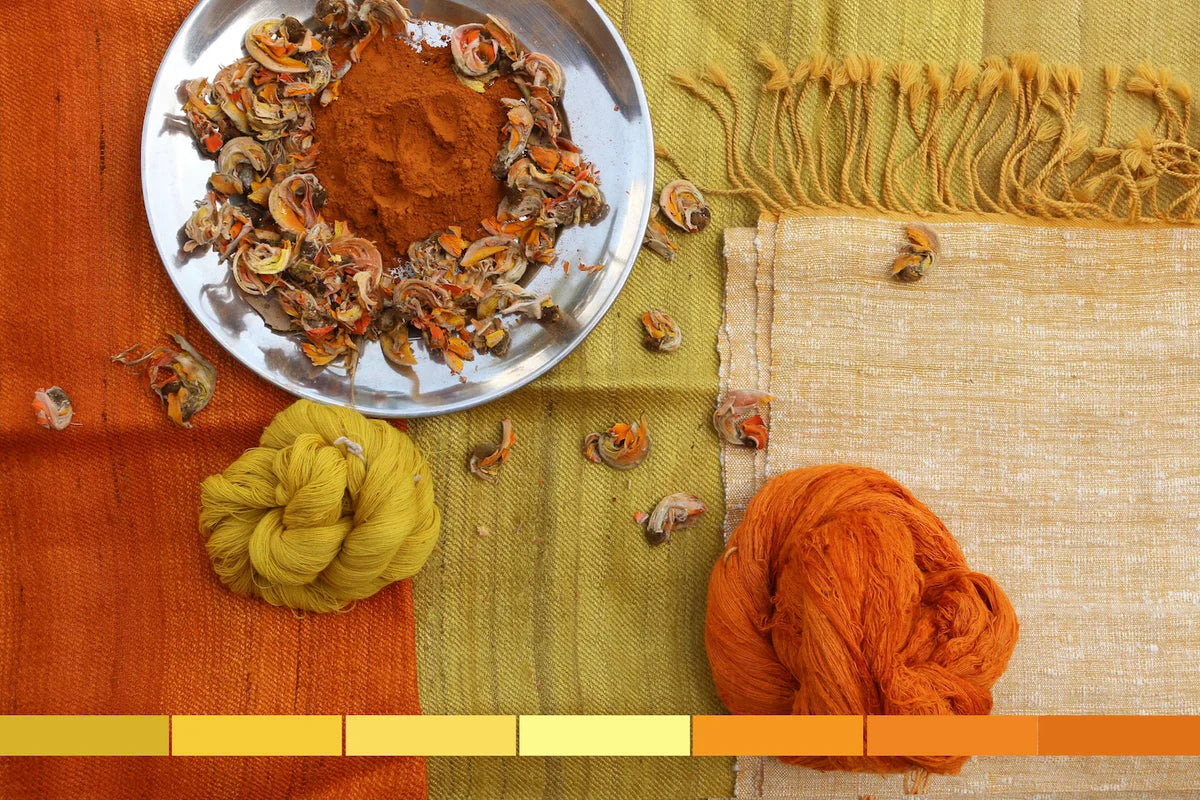
Tesu (palash) flowers are traditionally gathered after falling naturally from trees during spring. Once dried, their petals release luminous golden-saffron hues when soaked or simmered in water.
This dye has long been used in festive textiles and ceremonial colourings, symbolising warmth, renewal, and seasonal transition. Like many Rajasthan dyes, its source lies not in harvesting fresh blooms but in collecting what nature has already shed.
A Living Knowledge System
These dye traditions reveal a sophisticated understanding of plant chemistry, fibre behaviour, water minerals, and time. Artisans learned through generations that fermentation, drying, aging, and oxidation could transform humble botanical matter into lasting textile colour.
Rather than industrial uniformity, natural dyes produced subtle variation — shifts in tone influenced by soil, rainfall, season, and preparation. This variability became part of their beauty, embedding landscape and time into cloth itself.
Colour as Ecology
Traditional Rajasthan dyeing also reflected an ecological sensibility. Using fallen fruit rinds, dried flowers, and aged roots meant working with renewable or waste plant material. Dyeing aligned with agricultural cycles and forest rhythms rather than extraction.
Colour, in this sense, was not imposed on fabric but grown into it — drawn from the same environment in which cotton itself was cultivated.
 The Safeera Approach: Choosing Earth-Born Colour
At Safeera, we draw inspiration from these longstanding dye traditions of Rajasthan, where colour was historically derived from plant matter — roots, rinds, leaves, and flowers shaped by time and nature.
Wherever possible, we strive to use hues that originate from the earth rather than synthetic chemical dyes. Colours drawn from botanical sources carry a softness, depth, and irregular beauty that industrial pigments rarely replicate. They age gently, breathe with the fabric, and feel inherently closer to the skin.
This preference reflects both aesthetic and philosophy: colour as something grown, gathered, and transformed with care rather than manufactured for uniformity. While modern textile production often relies on synthetic colourants for speed and scale, Safeera continues to look toward plant-based traditions as the truest expression of textile heritage.
In this way, the Safeera palette remains rooted in the same landscape that shaped Rajasthan’s historic textiles — a spectrum born from soil, season, and living plants.


