

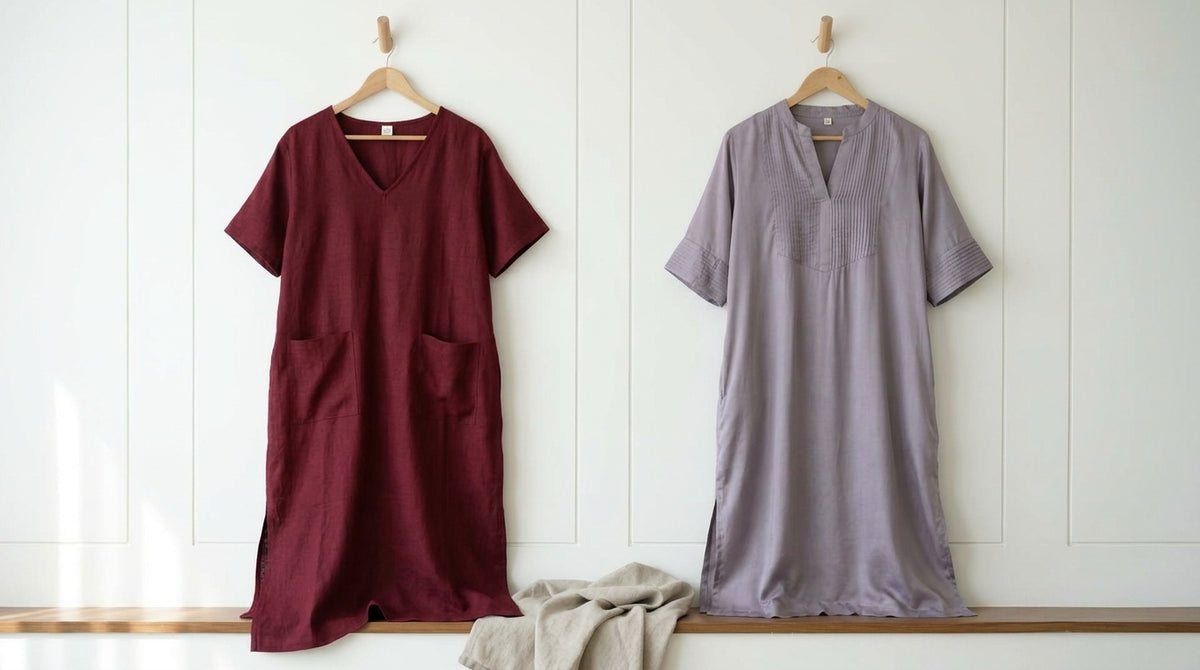
The best oversized kurta styles for women right now are the A-line, straight-cut with side slits, angrakha wrap, and high-low hemline silhouettes. Each works differently depending on your body shape, the occasion, and the fabric you choose, and that last part is where most people go wrong.
If you have ever ordered a kurta labeled 'oversized' online and received something that looked more like a sack than a silhouette, this guide is for you. We are going to walk through what actually makes an oversized kurta work, which styles are worth your money, how to size yourself correctly when shopping in India, and how to style them so the look reads intentional, not accidental.
Oversized vs. Loose: Why the Distinction Matters
An oversized kurta is deliberately cut with extra ease at the bust, waist, and hip, but it retains a considered silhouette. A loose kurta is often just a poorly fitted regular kurta. The difference lies in construction: an oversized kurta has structured seaming, a deliberate hemline, and a drape that holds its shape. A loose kurta simply has too much fabric with nowhere intentional to go.
Think of it this way. An oversized A-line kurta flares from the shoulder with a clean sweep. An ill-fitting regular kurta just bags at the waist and clings somewhere it shouldn't. When you shop for oversized kurtas, look for style descriptors like 'anti-fit', 'relaxed silhouette', or 'drop-shoulder' rather than just sizing up from your usual number.
The Best Oversized Kurta Styles for Women
A-Line Kurta
The A-line is the most flattering oversized silhouette for a wide range of body types. It is fitted (or at least defined) at the shoulder and chest, then flares outward toward the hem. This creates visual length and draws the eye downward, which works especially well for women with broader hips or a fuller midsection. Pair it with straight pants or fitted leggings and you have a proportioned look with zero effort.
Straight-Cut with Side Slits
This is the everyday workhorse. A straight-cut oversized kurta with deep side slits (ideally starting from the hip or higher) gives you all the comfort of a relaxed fit without the visual bulk. The slit is doing important structural work here: it breaks the solid rectangle of fabric and creates movement. Wear it over palazzo pants or wide-leg trousers for a co-ord feel, or pull it over your favourite baggy jeans (yes, this works, and we will get to that).
Angrakha Style
The angrakha is a wrap-style kurta that ties at the side or front, creating a defined waist point even in an oversized cut. It is one of the few traditional silhouettes that gives you the drama of an oversized fit while maintaining shape. If your main concern is looking shapeless, the angrakha is your answer. It is also one of the most beautiful silhouettes for handblock-printed fabrics because the wrap panels let the print breathe and show fully.
High-Low Hemline Kurta
Shorter at the front, longer at the back (sometimes dramatically so), the high-low hemline adds movement and dimension to an oversized cut. It works well in lightweight fabrics like mulmul or rayon because the uneven hem needs fabric that falls fluidly. Style it with slim-fit pants or leggings to balance the volume at the hem.
Cape-Style and Tiered Kurta
The cape-style kurta has an attached or separate cape layer that drapes over the arms, making it festive-ready without heavy embellishment. The tiered kurta adds horizontal layers that create structure. Both work best in slightly stiffer fabrics (more on that below) so the tiers or cape do not collapse inward.
Balloon Sleeve Kurta
Balloon sleeves are voluminous from the elbow to the cuff and add a playful, fashion-forward quality to even the simplest kurta. If you are choosing a balloon-sleeve style, keep the body of the kurta relatively streamlined so the sleeve remains the focal point rather than competing with overall volume.
Fabric Matters More Than Fit: Why the Wrong Fabric Ruins the Silhouette
This is the part most style guides skip entirely. In an oversized kurta, fabric weight determines whether your silhouette looks sculpted or shapeless.
- Cotton and mulmul: Lightweight, breathable, and ideal for Indian summers. Both drape softly but do not hold structure on their own, so they work best in A-line or high-low cuts rather than tiered or cape styles. Mulmul in particular has a fluid fall that looks beautiful in handblock prints. If you have sensitive skin, cotton is worth prioritising: you can read more about why cotton suits Indian skin in detail.
- Linen: Slightly heavier and crisper than cotton, linen holds its shape well in a straight-cut or angrakha silhouette. It does wrinkle, but a crumpled linen kurta reads as intentionally relaxed, not unkempt. Pre-wash your linen kurta once before wearing to soften the initial stiffness.
- Rayon: Drapey and fluid, rayon works well for high-low and tiered silhouettes because it falls cleanly. It is not as breathable as cotton or linen, so it is better suited for transitional weather or air-conditioned spaces.
- Handblock-printed cotton: The printing process adds a very slight hand to the fabric, meaning it holds its shape marginally better than unprinted cotton. This makes block-printed cotton a particularly good choice for A-line and straight-cut oversized kurtas where you want the fabric to fall without clinging.
For more guidance on matching fabric to occasion and silhouette, the breakdown in Kurta Designs for Women: How to Choose the Right Silhouette, Fabric, and Occasion is genuinely useful reading.
Recommended for you
-
 The Unrushed Oversized Kurta
Relaxed cotton-linen oversized kurta with an anti-fit silhouette for everyday wear.
-
 Adaa Modal Oversized Silk Kurta
Modal silk oversized kurta with refined detailing — ideal for festive occasions.
-
 Saanjh Cotton Linen Kurta
Breathable cotton-linen kurta in navy blue — a clean, everyday ethnic essential.
How to Find Your Size in an Oversized Kurta When Shopping Online
Oversized kurtas do not follow the same sizing logic as fitted garments, and standard Indian size charts (S to 5XL) can be wildly inconsistent across brands. Here is a practical walkthrough.
- Measure your bust (not your bra size): Use a soft tape measure, keep it parallel to the floor, and measure at the fullest point. This is your base measurement.
- Check the garment's finished bust measurement, not the 'fits up to' label: A kurta that 'fits up to 42 inches' might have an actual garment bust of 44 or 50 inches. Ask the brand, or look for finished measurements in the size chart. The gap between your bust and the garment bust is your ease. For an oversized kurta, you generally want 6 to 12 inches of positive ease depending on how relaxed the fit is meant to be.
- Check the hip measurement if the kurta is a straight or A-line cut: The kurta should have at least 4 to 6 inches of ease at the hip for comfortable movement.
- Check the length against your torso: A mid-thigh length kurta will sit differently on a 5'2" frame versus a 5'8" frame. Many brands list total garment length. Measure from your shoulder to where you want the hem to fall and compare.
- When in doubt, call or message the brand before ordering: A good slow fashion brand will walk you through measurements, send detailed product pictures, or offer a video call to help you decide. This saves you the hassle of returns entirely.
Styling Oversized Kurtas: Everyday Wear vs. Festive Occasions
For Everyday Wear
An oversized straight-cut cotton kurta with side slits over wide-leg pants or even well-fitted baggy jeans is a fully intentional, polished look. The key is contrast in fit: if the kurta is voluminous, the bottom should be fitted enough to show that you made a choice. Slim straight pants, cigarette trousers, or fitted jeans all work. Avoid pairing an oversized kurta with very wide-leg palazzo pants unless you are very comfortable with volume-on-volume styling.
Footwear: flat kolhapuris, block-heeled sandals, or even white sneakers work well for daily wear.
For Festive and Wedding Occasions
The angrakha, cape-style, or tiered kurta in a handblock print or Ikat fabric reads immediately festive without needing heavy embroidery. Add a scarf in a contrasting print as a dupatta alternative, or layer with statement silver jewellery to elevate the look. Dhoti pants or wide-leg silk-blend pants work beautifully under a festive oversized kurta.
You do not need a dupatta unless you want one. A well-chosen oversized kurta in a craft print holds its own.
Craft Traditions Worth Knowing: Block Print, Ikat, and Bandhej in Oversized Silhouettes
Craft-based oversized kurtas age better than trend-driven ones, in the literal sense. Bagru handblock prints, Sanganeri florals, Ikat weaves, and Bandhej tie-dye patterns are rooted in centuries of Indian textile tradition. They do not go out of style because they were never chasing a trend in the first place.
In an oversized silhouette, a bold block print has room to show itself fully. A Bagru print with its earthy madder and indigo tones, or a Sanganeri floral in soft pinks and creams, looks entirely different on a fitted kurta versus an A-line oversized cut where the repeat has space to breathe.
Ajrakh and Dabu prints (resist-printing techniques from Rajasthan and Gujarat) have geometric patterns that suit the clean lines of a straight-cut oversized kurta particularly well. If you have not explored craft-based kurtas yet, an oversized silhouette is arguably the best starting point because the relaxed cut lets the textile be the star.
Common Fit Mistakes (and How to Fix Them)
- Shoulder seam drooping past the shoulder: This is the clearest sign of ill-fitting, not intentional oversize. On a true drop-shoulder or oversized kurta, the seam may be designed to sit lower, but it should look deliberate. If it is pulling or bunching, the garment is simply too large in the shoulder, not intentionally oversized.
- Sleeves that are too long and wide: In an oversized kurta, sleeves should be comfortable but not engulfing. Check sleeve length (wrist to shoulder) and width (upper arm circumference plus ease) before buying online.
- Pairing with the wrong bottom for your frame: For fuller figures, a straight-cut or A-line oversized kurta works better than a tiered or ballooned style because the volume is more controlled. Tiered kurtas add horizontal bulk, which can feel overwhelming in larger sizes unless the tiers are very narrow.
- Going too long: An oversized kurta that hits the ankle on a petite frame reads as a dress, not a kurta. Mid-thigh to knee length is generally the most versatile range.
Keeping Natural-Fabric Oversized Kurtas Looking Good Over Time
Natural fabrics are worth the small amount of extra care they ask for.
- Handblock prints: Cold water, mild detergent, and no prolonged soaking. Turn the kurta inside out before washing to protect the print. Line dry in shade, not direct sun, to prevent colour fade.
- Cotton and mulmul: Machine wash on a gentle cycle or hand wash. These fabrics soften beautifully with each wash rather than degrading.
- Linen: Hand wash or machine wash cold. Accept the wrinkles or iron slightly damp. Avoid high heat drying.
- Avoiding shrinkage: Pre-wash before your first wear. Most natural fabrics shrink once and then stabilise. If you are between sizes in an oversized kurta, sizing up and pre-washing is a good strategy.
- Storage: Fold rather than hang heavy cotton or linen kurtas to avoid shoulder distortion over time.
Frequently Asked Questions
What exactly is an oversized kurta and how is it different from a regular loose kurta?
An oversized kurta is intentionally designed with extra ease at the bust, waist, and hip, and has a deliberate silhouette, such as an A-line sweep or a structured straight cut with side slits. A loose kurta is usually just a regular kurta with too much fabric and no considered shape. The key difference is intentionality in construction, not just size.
Which oversized kurta style suits a curvy or full-figured woman best?
The A-line and angrakha styles tend to work best for curvy or full-figured women. The A-line creates visual length and skims rather than clings, while the angrakha's wrap construction defines the waist even in a relaxed fit. Avoid tiered or balloon-heavy styles if you want a cleaner silhouette, as they add horizontal volume.
How do I find my correct size in an oversized kurta when shopping online in India?
Measure your actual bust circumference (not your bra size) and compare it against the garment's finished bust measurement listed in the size chart, not the 'fits up to' label. For an oversized kurta, you generally want 6 to 12 inches of positive ease between your measurement and the garment measurement. Also check total garment length against your own torso measurement. When in doubt, contact the brand directly before ordering.
Can oversized kurtas be worn with baggy jeans and still look intentional?
Yes, a straight-cut or A-line oversized kurta with side slits over well-fitted straight-leg or slim jeans looks completely intentional. The contrast between the relaxed kurta and the fitted jean is what makes it work. Avoid pairing an oversized kurta with very wide, shapeless jeans unless you are deliberately going for a maximalist layered look.
What fabrics work best in an oversized silhouette for Indian summers?
Cotton, mulmul, and linen are the top choices for Indian summers in an oversized silhouette. Cotton and mulmul are lightweight and breathable with a soft drape that suits A-line and high-low cuts. Linen is slightly crisper and holds shape well in straight-cut silhouettes. Handblock-printed cotton adds a subtle hand to the fabric that improves drape and structure.
Do oversized kurtas work for weddings and festive occasions, or only for casual wear?
Oversized kurtas absolutely work for festive occasions when you choose the right style and fabric. An angrakha or cape-style kurta in a handblock print, Ikat, or Bandhej fabric reads festive without heavy embellishment. Style it with dhoti pants or wide-leg trousers and silver jewellery to elevate the look.
Will natural fabric kurtas like cotton or linen wrinkle too much to look polished?
Linen wrinkles are part of the fabric's character and generally read as relaxed and intentional rather than unkempt, especially in an oversized silhouette. Cotton and mulmul wrinkle less and smooth out quickly with wear. Removing garments from the wash promptly and shaking them out before drying reduces wrinkles significantly. If you iron linen, do it slightly damp for best results.


